Organizing Work, Not Conversations
Designing persistent investigation workspaces that preserve context across tasks.
Project Summary
- Role
- Product Designer
- Duration
- 8–10 weeks
- Team
- Product Designer, Founder, Product Manager, 2 Engineers
- Platform
- Web · AI-native Security Platform
- Tools
 Cursor
 Figma
Figma Claude Code
 GitHub
 Vercel
- Scope
- AI UX · Design Engineering · Prototyping · Frontend Implementation.
- Validation
- Internal design reviews, engineering feedback, and demo conversations at RSAC
Context and problem
Neo is an AI security engineer by ProjectDiscovery. Security teams use Neo to conduct reconnaissance, test APIs, identify vulnerabilities, and perform penetration testing using autonomous agents.
Every user prompt created a separate task. This worked well for individual requests, but as investigations grew, related work became fragmented across multiple tasks. Users had to search previous conversations and manually reconstruct the context.
It quickly became clear that the problem wasn't having too many tasks. Security engineers organize their work around targets like domains, APIs, and CVEs, not individual conversations. Neo understood each task, but it had no understanding of the investigation connecting them.
The challenge was to redesign Neo's information architecture so investigations, not individual tasks, became the primary way users organized and revisited their work.
Process
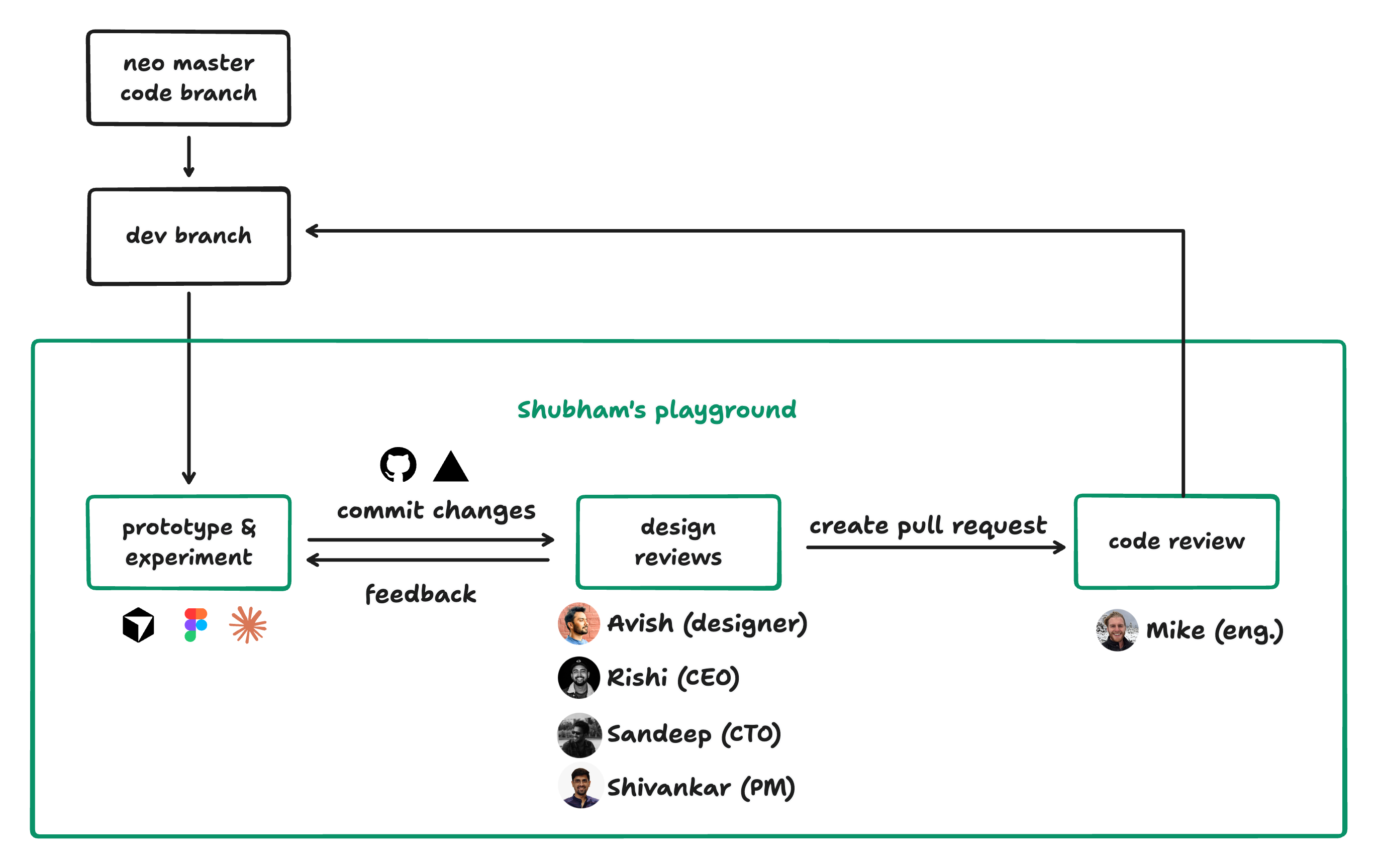
I worked directly in Neo's development branch, using Cursor to prototype ideas before refining them through design reviews and engineering feedback. This workflow let me iterate quickly and validate interactions before they shipped.
Giving tasks a Home
I introduced Projects as a layer above Tasks, using a secondary sidebar for tasks to make the relationship between the two. Existing workflows remained unchanged, while related tasks were grouped into a shared investigations with its own context and metadata.
Making projects easier to access
As Projects became the hub for context, I explored ways to make them easier to access. Users often switched between Tasks and Projects for the same investigation.
The separation made sense conceptually, but it increased navigation overhead and fragmented the experience. To address this, I moved Projects closer to the primary workflow and introduced dedicated project management experiences for discovery, filtering, and organization.
Bringing Project's Context Together
Projects established a shared place for investigations, but they still acted primarily as containers for tasks. Users had to move between different parts of the product to understand findings and investigation issues.
I redesigned Projects as self-contained workspaces where tasks, findings, and future workflows could coexist. This brought investigation context into one place, reduced navigation, and made Projects the primary workspace for security investigations.
Unifying navigation around work
As Projects matured, Tasks and Projects followed two different navigation patterns despite being closely related concepts. This inconsistency added unnecessary complexity to everyday workflows.
I redesigned the navigation so both followed the same interaction model. Hovering either item opens a dedicated secondary sidebar, making navigation more predictable while creating a scalable foundation for future capabilities.
Reflection
When I started this project, I thought I was solving a task organization problem. As the work evolved, I realized the real challenge was preserving context across long-running investigations.
Projects became the foundation for how Neo organizes work today. They gave investigations a persistent home for tasks, files, issues, and collaboration while creating a scalable structure that later features could naturally build upon.
The biggest takeaway for me was that information architecture isn't about organizing screens. It's about organizing work in a way that matches how people already think.